

Community collaboration, pilot events, a corporate innovator survey, and lots of field conversations to pull “corporates” into the enterprise tech ecosystem and engage directly with startups. Here’s what we tested, what we learned, and recommendations for community builders. (tl;dr - research download below)

A little over a year ago, I dove into the Philly tech scene with a conviction: Philadelphia best represents the country’s enterprise tech market. A cross-representation of industries. Hundreds of midmarket and dozens of F500 companies within easy reach. Not the bleeding edge adopters (generally), but the real buyers, making it an ideal testbed for B2B startups with pragmatic solutions. (“If you can make it here, you’ll make it anywhere” is probably a better fit for Philly than NYC in this context ;). As AI development evolves from frontier models to applied solutions, there’s no more practical and logical place for enterprise startups to build and grow.
🔎First, a lot of field observation: I attended dozens of events across the ecosystem to explore, lit up from the energy of Philly Tech Week: startup pitch events from the Road to Lion Cage to the Lion’s Den, developer events, Ground Floor meetups, Chamber business outlooks, angel events, Founder Fridays and Founders Alley, entrepreneur workshops, Innovation Weekend, monthly Tech Leaders meetings, university panels at Penn and Temple, working groups, and more. Clear momentum. So much talent. Lots of great people.
The challenge was getting the business side (“corporates”) engaged with Philly’s enterprise tech community. Their absence was notable (Comcast aside - the hero!) and their presence essential to becoming a serious enterprise tech hub. We need them directly involved in validating, testing, and adopting the solutions built in their own backyard.
Successful early pilots accelerate the path to land and expand. Being local makes it much easier to build deeper relationships with early customers, transforming them into trusted “ambassadors” who attract the next wave of buyers.
Corporates benefit from access to early innovation (and pricing), competitive edge, brand building (corporate and personal), and supporting the greater good of regional growth.
A concentrated geographic market is resource efficient for bootstrapping startups and savvy investors.
Strong corporate/startup partnership is a credibility (brandsignal for Philly to the rest of the world. This was one of the biggest takeaways from my past involvement around the Paris ecosystem.
I talked with lots of founders, too, both 1:1 and in small forums. Consensus: Getting startups in front of Philly’s corporate innovators is nearly impossible cold.
That’s the first problem to solve - create the conditions that bring corporate innovation leaders together with promising startups.
And with a lot of insight from the community and the fantastic collaboration of Philly Builds AI, we set out to validate it.
We went about it methodically: a thesis and problem definition, listening sessions and research across the community, and a variety of activities to confirm product-market fit.
Given the deep work of so many involved, I wanted to capture, synthesize, and share our collective experience in this groundwork. It can be helpful to both the big-picture regional commitment to make Philly a recognized hub for enterprise innovation, and the many individual groups (grass-roots and formal) each focused on different elements.
Here are the conclusions — what we did, what the research shows, and what the playbook looks like for Philly’s (enterprise) ecosystem builders. (You can download the survey report and recommendations🎁, below.)
Take what’s useful!
What We Built
💡The pre-sell and concept testing:
Late last summer into fall, I shared the Enterprise Lab’s premise with people representing the various ingredients - founders and corporate tech leaders at the core, and ecosystem builders, economic development groups and accelerators surrounding them. Philly is tight-knit, and many folks have built, led, and participated in different initiatives across different eras of the startup scene, with some crossover (and some silos).
This was critical to learn what’s been done and worked before, understand the changes over time (there’s a definite pre- and post-Covid), share insights about what’s missing, and get buy-in. Each person had valuable perspectives, and was generous in introductions to others.
👥The collaboration:
Those introductions led to Grace Francisco, who was gathering leaders across the ecosystem in a formal alliance — what’s now Philly Builds AI — to break those aforementioned silos and raise Philly’s profile. She invited me to share the concept with her group. Philly Builds AI then “powered” the Enterprise Lab initiative, providing the platform for information sharing and a dedicated working group for collaboration. (Too many names to mention here 💚 — they’re in the report at download below ⬇️. ) This was the engine that fueled it through visibility, momentum, ongoing communication, and accelerated execution.
🧪The pilots:
We ran six events from March to June, each designed to test different angles.
Phorum ecosystem workshop — The kickoff. Does the broader ecosystem want to organize around this idea? PACT gave us a lunchtime session at their annual conference, where 25 people, mostly non corporates, showed up to share their opinions. That they were mostly “non corporates” and that we ran out of seats, was both telling in participation and signal enough for the next event to get the enterprise folks to the table. (Read the recap.)
Corporate Innovators Roundtable at Fitler Club — The key question: Do senior business leaders actually want to engage with startups - and how? Almost fifty folks across the community participated in the discussion, with representation from Aramark and TruMark, Parkway and Medtronic, Riggs Distler and Weidenhammer, Bank of America and Comcast, Philly Commerce and PA CDEC, along with startup founders and ecosystem champions. We opened with a panel including Rick Nucci, Marek Gootman, and Grace Francisco to make the business case for a stronger corporate involvement, and then listened to attendees’ specific guidance. IMO, the sponsorship and outreach by the Chamber of Commerce gave us legitimacy to attract that corporate audience. (Recap.)
Enterprise Sherpas Series — Three fireside chats with successful operators and investors for early-stage founders were held at Fitler Club and sponsored by Ben Franklin Technology Partners. With 120+ registrants in total, 20 to 30 folks attended each session: Mark Gaeto on Business Model Planning, Paul Melchiorre on Enterprise Selling (recap), and David Horowitz on Corporate Venture 101. (A next round featuring breakout founders is most wanted.)
AI Discovery Lab at Technical.ly Builders Conference — A showcase event inside Technical.ly’s sold-out Builders Conference was intended to bring buyers and builders together to learn from each other. A live interview with RJ Juliano, Senior VP of Parkway Corporation, served as a real-world case study on common AI adoption challenges, with FSH Technologies, Guru, Naftiko, NextGres, and Sondera sharing their related solutions and expert advice with attendees. (Recap)
All with positive feedback, each with specific learnings on how to improve (feel free to reach out), and only possible through our working group and supporters.
📋The research:
To pull corporates in, we had to ask them what they want. The idea was to design “Business-First” programming so they’d participate. (Getting the startups to engage is a no-brainer!) We launched a survey for corporate innovation leaders to ask about their:
Current engagement in the ecosystem — and what would get them more involved
Priorities for AI adoption — and what they want to learn
Interests and preferences in working with startups
The 19 qualified responses were directionally significant to structure a real program playbook. Here are the top-line, most actionable findings (with more in the research deck available for download at the end of this piece ⬇️):
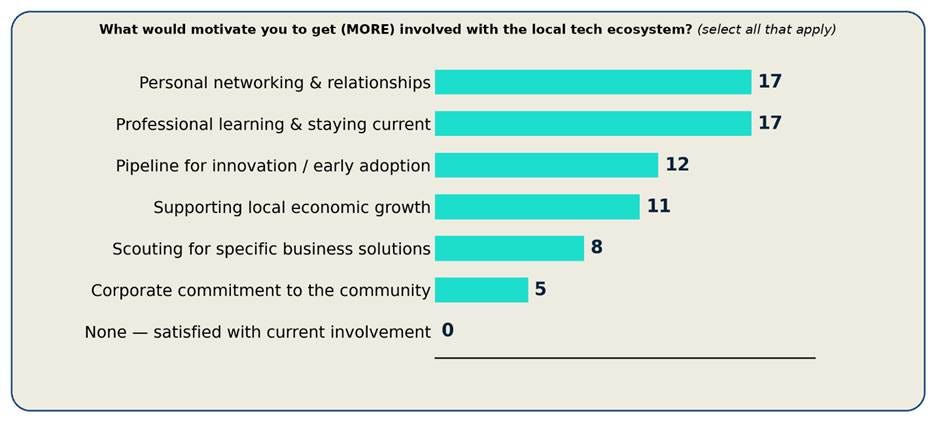
1. Corporate innovators see personal, business, and community value in engaging in the ecosystem. The baseline question to answer is, bluntly, “WIFM” — what’s in it for me? The responses show they want to engage for their direct value, and to support the overall region. Their motivations cluster into four orientations that can shape programming: Peer Community (ongoing trusted network), Peer Learners (real implementations and expert depth), Solution Pipeline (builders solving their problems), and Economic Boosters (showcasing local tech for growth).
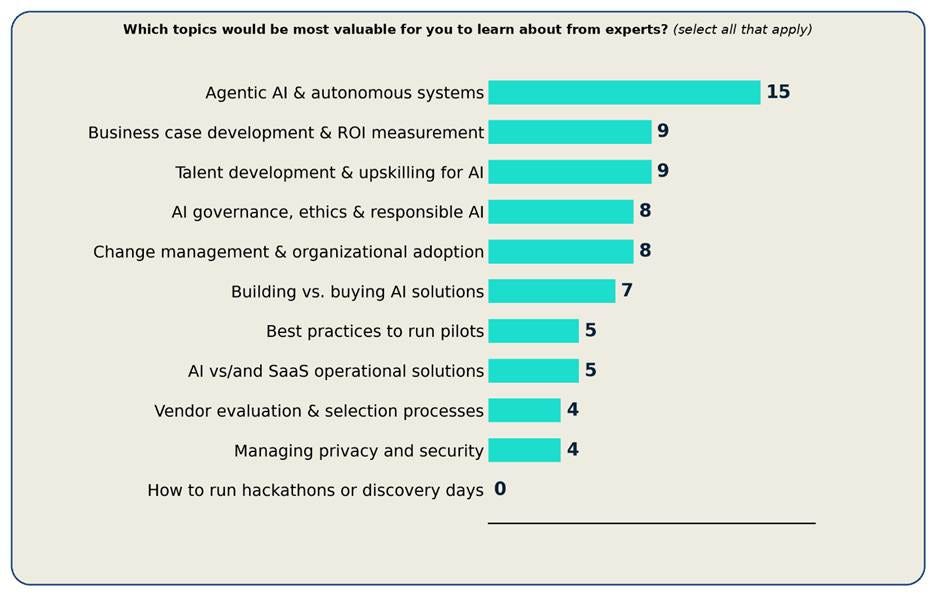
2. What corporate innovators want to learn most starts with agentic systems and extends to the transformation of the organization itself. We asked about their priorities for AI adoption, and then what they want to learn from experts. Highlighting that response here, as this particular question is most interesting for communities to lean into. “How do we pilot it, govern it, get our people to adopt it sustainably, and measure it?” are exactly the questions where peer learning, and expertise from local builders (and consulting experts) create the most value. Note that these are largely industry-agnostic.
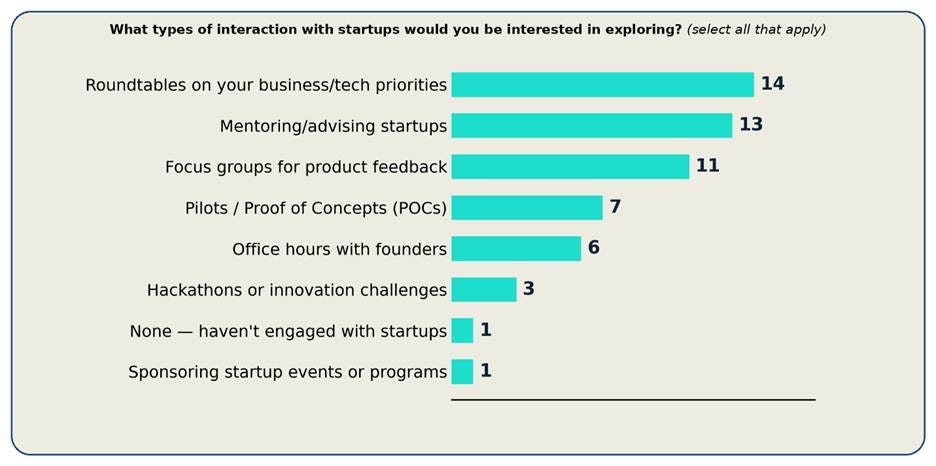
3. Corporate leaders want focused, meaningful interaction with startups — not pitch events. We were delighted with the responses here. This is how “give-to-get” relationships start, based on trust and the exchange of expertise.
📢The communication:
Building in public only works if there’s an actual audience — that’s where the accountability and momentum happens. And if we don’t communicate what we’re doing, nobody knows there’s a way to get involved.
Guest posts in Technical.ly were invaluable to provide context for the initiative and credibility with supporters.
EnterpriseLabPHL.com went live early March as an anchor for the initiative and individual programs, linking to events and surveys. Approximately 600 visitors in the first month alone, almost all from within the region.
Weekly (sometimes daily) LinkedIn posts (sorrynotsorry for deluging your feeds ;), to promote our activities and spotlight the people and companies participating in them. Approximately 20,000 views over 90 days, with additional cross and direct promotion through Philly Builds AI, partner networks (Chamber, BFTP, Technical.ly, PACT, Fitler), and the “cheerleading” individuals who also posted and shared 😇.
What We Learned
📍The demand is real. This was the foundational hypothesis, and it held. Corporate leaders engaged. Founders engaged. The ecosystem was extraordinarily generous and supportive in their contributions. When the two sides find each other — through shared learning, matched expertise, and structured engagement — the result isn’t just better programming. It’s a sustainable local innovation ecosystem: more solutions built to spec, more pilots that lead to real adoption, more startups that grow here because their best customers are here.
📍We found potential corporate champions. Enough people raised their hands and said: yes, I’m interested in this. I’ll engage with startups, offer feedback, participate in sandboxing, be a real partner, serve as an advisor to signal the real opportunity. These are the people the ecosystem has been looking for. A small cohort to start matters. They are the most precious element, and need to be coordinated carefully, not burned through. Let early champions do their thing quietly at first, and create FOMO to pull in others.
📍Startups are ready. Our founders are hungry for exactly what the corporate champions can offer: honest feedback, MVP validation, a path to lighthouse customers. Just a caveat: the cross-participation mindset for founders shouldn’t be hard selling. That’s a definite turnoff. Vetting is prerequisite to curation. They need to be triaged by solution focus, stage, and ideal customer profile. We also created a survey for this, to ultimately publish a similar study and a “Builder Directory” for the community. (It’s live currently. Happy to transition it a community group that’s interested.)
📍The best format is carefully curated. Not big conferences. Not broadcast content. Deliberate participant selection, structured themes, and plenty of room for open conversation to share experiences. The survey and our roundtable session both confirmed this.
IMO, the AI Discovery Lab could be the most intriguing concept to bring both sides together: A real-life “how we’re doing it” case study, with corporate peers asking questions and sharing their own experiences, surrounded by curated vendor experts.
The Sherpas concept gives founders access to those who’ve done it, a community to share experiences and learn from each other, plus content for Philly-based success stories (something sorely needed for broader visibility). Sherpas apply to the corporate side, too, to share AI adoption best practices - and opening such sessions to invite startups to listen would be valuable.
📍Infrastructure exists within the community. This doesn’t need to be built from scratch. The model itself isn’t new. Whether broad new initiatives such as the Chamber’s Greater Philadelphia Growth Platform, mature ecosystem institutions, independent and investor-backed accelerators and incubators, university commercialization teams, grass-roots groups — each has their potential “corporates” cohort as members, alumni, and boards to share AI adoption experiences and match champions with qualified startups. It “just” takes a concerted focus to pull and pair them.
🚩It’s a significant commitment to sustain. What started out as a passion project quickly became a full-time job. (Not a complaint, but an honest recognition. It was an absolute pleasure.) It could only have been done with the “village” of the community who shared insights, gave time, attended events, hosted and sponsored activities, and more. And perhaps an outsider POV was arguably the most objective way to validate the need. But it needs dedicated resources. That’s why it’s an “open-source” opportunity to take it further from here.
What the Community Can Do Next
There are three things to pick up from what we found here, each quite different:
Collaborative learning. What corporate tech leaders told us directly about what they want and how they want to engage is applicable to the individual communities already doing great engagement with their members/audiences. Invite the “other side” to the table to share expertise and learn together.
From investor pitch events to corporate focus groups. Investor pitch competitions are always interesting. But perhaps expand the concept to consider it from the enterprise buyer lens - especially for the early-stage builders. The feedback and validation from corporate innovation leaders on value prop, message clarity, need vs. nice-to have, and who’d be involved in the buyer and customer journey can have more immediate impact than the “TAM/SAM/SOM Moat” perspective of investors. It’s not either/or, and would improve the quality of the investor pitches automatically.
Sustainable structure. What’s needed is a committed team to hold the organizing function itself: activating potential corporate champions), triaging the startups, and curating the matches. For any group positioned to sustain this, a lot of the groundwork is done.
More details are in the Enterprise Innovators Research deck (download below ⬇️). It includes our survey findings and the specific recommendations on programming topics, formats, audience mix, and what should come next.
The high-level formula to consider:
Curate both sides (don’t just fill seats)
Give corporate champions a learning context to establish trust with founders
Build corporate-focused, peer programming around these shared “what keeps you up at night” issues. These are industry agnostic - security, governance, workforce development, etc. - and provide an opening for startups to share expertise
Match builders by business problem domains and stage, not just industries
Engage successful founders, investors, and operators as “sherpas” to bring their experience to emerging startups and create a strong founder community. (Same for the business community: The lessons learned of AI adoption leaders have so much value to peers.)
One final thought: Of Gratitude
With a year of immersion in the community, my biggest personal takeaway is that of deep appreciation for the talent, experience, generosity, and connectivity - and Philly pride - here at home. The support was extraordinary beyond words and the relationships deeply meaningful. 💚 This initiative couldn’t have happened without it.
This is the open-source roadmap. Take what’s useful.

With special thanks to Philly Builds AI, the Chamber of Commerce, Ben Franklin Technology Partners, PACT, 1PHL, Technical.ly, and Fitler Club. The many, many individuals who supported this initiative 🙏 are gratefully acknowledged in the Research and Recommendations Report download here ⬆️.
Bonnie Ravina has spent more than 25 years at the center of enterprise tech, working with emerging startups and category creators as they become market leaders. Her focus today is working with product-ready B2B startups on buyer-ready narratives and priorities to find their market footing. Bonnie is the founder of Full Circle, a boutique marketing firm for US and international tech companies. She has also served as an operating partner at a Paris-based VC and on the founding management team of SAP in the US, leading its breakthrough ERP launch. Based in Philadelphia, she created the Enterprise Lab as a community initiative to better connect Philly’s corporate innovators with enterprise startups.
Bonnie, thank you for sharing this experience ! My experience and sentiments agree that Philly is like a lot of places and engaging for the future of innovation is dependent on all of us!